Commercial Roof Leak Repair: Why Your Roof Leaks and How the Source Is Found
Most commercial roof leaks do not start where the water shows up inside the building. Water enters at a seam, a fastener, a piece of flashing or a penetration, then travels along the deck or through the insulation before it drops through the ceiling.
That is why patching the ceiling stain almost never works, and why finding the entry point matters more than the repair itself.
It is also why a leaking roof does not automatically need replacing. On a structurally sound commercial roof, the leak is usually a failure at a specific detail rather than a failure of the whole roof.
Call 814-952-2469 for a free roof inspection.
Where Do Commercial Roof Leaks Usually Start?
Six places account for the large majority of commercial roof leaks.
1. Seams and laps
Wherever two pieces of roofing meet, there is a joint that has to stay sealed while the roof expands and contracts. On single ply membranes the seams are welded or adhered. On metal roofs the laps are fastened and sealed.
Seams are the most common starting point for a commercial roof leak, and they usually fail gradually rather than all at once.
2. Fasteners
Exposed fastener metal roofs rely on a rubber washer under every screw head. Those washers harden and shrink over years of heat, cold and sunlight, and screws can back out slightly as the panels move.
A roof with several thousand fasteners has several thousand potential entry points, which is why fastener related leaks often appear in more than one place at once. This is the usual story behind a metal roof repair.
3. Flashing
Flashing is the detail work where the roof meets something else: a wall, a parapet, a curb, a chimney. It is fabricated and fitted rather than rolled out, so it depends heavily on workmanship.
Failed flashing is one of the most common causes of a leak that seems to come from nowhere.
4. Penetrations
Every pipe, vent, drain, skylight, conduit and equipment mount is a hole cut deliberately through a waterproof surface and then sealed around.
Sealant at penetrations has a shorter life than the roof around it, so on an older roof these are among the first things to check.
5. Drains and ponding areas
Water that sits on a roof finds weaknesses that shedding water never would. Ponding puts constant pressure on seams, accelerates coating breakdown and makes any existing defect worse.
Blocked drains and scuppers turn a minor drainage issue into standing water across a large area.
6. Storm and hail damage
Hail can bruise a membrane or dent metal panels without producing an obvious hole, and wind can lift edge flashing and loosen fasteners.
Damage from a storm frequently does not leak immediately. It leaks in the following season, which makes the connection to the storm easy to miss.
Why Is the Leak Never Directly Above the Wet Patch?
Because water follows the path of least resistance rather than gravity alone.
Once water is through the roofing surface, it can run along the top of the deck, travel down a purlin or beam, move sideways through wet insulation, and drop through the ceiling many feet from where it entered.
On a metal building it can run along a purlin the full width of a bay. On a flat roof with saturated insulation it can spread in every direction.
This is the single most useful thing to understand about a commercial roof leak. The wet patch tells you that you have a problem. It does not tell you where the problem is.
How Do You Find the Source of a Commercial Roof Leak?
Tracing a leak properly means working from the inside out and the outside in.
From inside, the deck, purlins and insulation above the wet area are examined for staining and travel paths, which usually points uphill toward a smaller number of likely entry points.
From outside, the corresponding roof area is inspected in detail: seams probed, fasteners checked, flashing and penetrations examined, drainage assessed and any storm damage identified.
Where insulation is suspected to be wet, moisture surveys can map the saturated area, which matters because wet insulation is a repair in its own right and not something a surface fix will solve.
Can a Leaking Commercial Roof Be Repaired, or Does It Need Replacing?
In most cases it can be repaired. A leak is usually a failure at a detail rather than a failure of the roof as a whole.
Repair is generally the right answer where the deck and structure are sound, the insulation is dry, and the leaks are traceable to specific seams, fasteners, flashings or penetrations.
Replacement becomes the better option where insulation is saturated across a large area, where the deck or structure has deteriorated, or where the roofing material itself has reached the end of its service life and repairs are no longer holding.
Between those two there is a third option that many building owners are not offered. A roof that leaks in several places but remains structurally sound can often be repaired and then coated, which addresses the existing leaks and protects the roof going forward without a tear off. That is what a roof restoration is.
Why Do Roof Leaks Get Worse in a Pennsylvania Winter?
Because of repeated freeze and thaw cycles. Around Rossiter, Punxsutawney, Indiana and Johnstown, winter temperatures move above and below freezing repeatedly rather than staying cold.
Water enters a small opening at a seam or fastener, freezes, expands and makes the opening slightly larger. It thaws, more water gets in, and the cycle repeats. A gap that was not leaking in October can be leaking by February.
This is why fall is the practical time to deal with a known leak. There is more detail on snow, ice damming and thaw leaks on our page about a roof leaking after snow.
What Does Commercial Roof Leak Repair Cost?
It depends on what is actually leaking, how much of the roof is affected and whether any insulation has been saturated.
An isolated repair to a flashing detail or a run of seam is a different job from a roof with widespread fastener failure, and a roof with wet insulation carries the additional cost of removing and replacing the wet material.
This is why an inspection comes before a price. A quote given without tracing the leak is a quote for a guess. For restoration work there are published ranges on our commercial roof coating cost page.
What Should You Do Now If Your Roof Is Leaking?
- Protect what is underneath. Move stock, equipment and anything electrical out of the affected area.
- Photograph the inside damage, with dates. This matters if an insurance claim follows.
- Note the conditions. Does it leak in every rain, only in heavy rain, only with wind from one direction, or only during a thaw? That pattern is genuinely useful diagnostic information.
- Do not send anyone untrained onto the roof. Wet commercial roofs are dangerous, and walking on a damaged membrane makes the repair larger.
- Get the leak traced before winter rather than after.
Repairing Leaks With a Conklin Restoration System
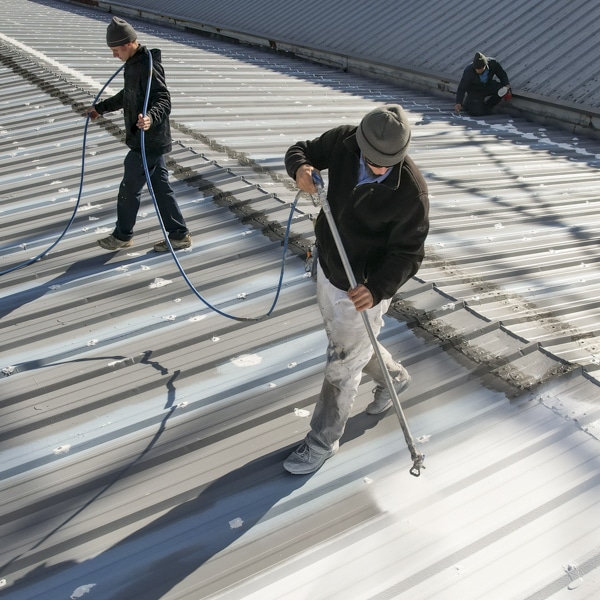
Where a roof is leaking in several places but the structure and insulation are sound, repairing the details and then coating the whole roof solves the existing leaks and protects the roof going forward, without a tear off.
Lester’s Roofing & Carpentry is a certified Conklin Roofing Systems contractor. Conklin’s acrylic elastomeric and fabric reinforced systems are used to reinforce seams and details and then seal the roof as a single surface.
- A seamless membrane over the existing roof, with seams, fasteners and penetrations reinforced first.
- White reflective surface that can reduce cooling costs by up to 30%.
- Rated by the Cool Roof Rating Council and FM Approved.
- Suitable for most substrates, including asphalt, concrete, CSPE, EPDM, metal, modified bitumen, PVC, TPO and wood.
- Adds very little weight to the building compared with a second roofing layer.
Where a Conklin restoration system is suitable, it carries a 20-year non-prorated manufacturer warranty, with the option to renew for a further 20 years, subject to the system installed and its renewal requirements. Lester’s Roofing & Carpentry also provides its own 3-year contractor workmanship warranty. There is more on our roof warranty page, and keeping that warranty in force depends on a maintenance program.
Commercial Roof Leak Repair: The Bottom Line
A leaking commercial roof is usually a failure at a specific detail, not a failed roof. Seams, fasteners, flashing, penetrations, drainage and storm damage account for most of them.
The water almost never enters directly above where it appears, so tracing the source is the part of the job that decides whether the repair works.
For a roof that is structurally sound with dry insulation, repair is usually the right answer, and repairing and then coating is often the option that solves the leaks and protects the roof at the same time.
Free Commercial Roof Inspections in Pennsylvania
Lester’s Roofing & Carpentry is based in Rossiter, Indiana County, and has been repairing commercial, industrial and agricultural roofs across western and central Pennsylvania for over 16 years. We are a registered Pennsylvania Home Improvement Contractor, HIC #PA042939.
We provide free roof inspections throughout Indiana, Cambria, Clearfield, Somerset, Blair, Jefferson, Armstrong and Westmoreland Counties, including Rossiter, Punxsutawney, Indiana, Johnstown, Ebensburg, Altoona, Clearfield and Huntingdon.
You get the leak traced, a written report with photographs, and a straight answer on whether the roof needs a repair, a restoration or a replacement.
Call 814-952-2469 or contact us to arrange an inspection.
Roof Leaking Now?
Get the leak traced before winter
5 Star Google Reviews