
Commercial Roof Types
Seven roofing systems account for almost every commercial building in Pennsylvania: TPO, EPDM, PVC, modified bitumen, built-up roofing, metal and spray polyurethane foam.
Commercial roofs differ from residential roofs in two ways that decide everything else. They are larger, and they are usually flat or low-slope, which means water leaves slowly rather than running straight off. That is why commercial roofing is built around membranes and seams rather than shingles, and why drainage matters more than almost anything else.
This page explains what each system is, how long it lasts, what it suits, and where it tends to fail. If your roof is already installed and ageing, the last section covers whether it can be restored rather than replaced.
Commercial Roof Types Compared
| Roof type | Typical lifespan | Best suited to | Main weakness |
|---|---|---|---|
| TPO | 15 to 25 years | Flat roofs where cooling costs matter | Seam welds fail first |
| EPDM | 20 to 30 years | Flat roofs in cold climates | Black surface absorbs heat |
| PVC | 20 to 30 years | Restaurants and plants with grease or chemical exhaust | Higher material cost |
| Modified bitumen | 10 to 20 years | Smaller flat roofs and re-covers | Shortest life of the group |
| Built-up (BUR) | 15 to 30 years | Roofs with heavy foot traffic | Heavy, slow to install, hard to inspect |
| Metal | 30 to 45 years | Sloped roofs, agricultural and industrial buildings | Fasteners and seams leak before panels fail |
| SPF | 20 to 30 years with recoating | Irregular roofs and roofs needing added insulation | Application is weather dependent |
Those lifespans are design lives rather than guarantees. Drainage, installation quality and maintenance decide where in the range a roof actually lands.
TPO Roofing
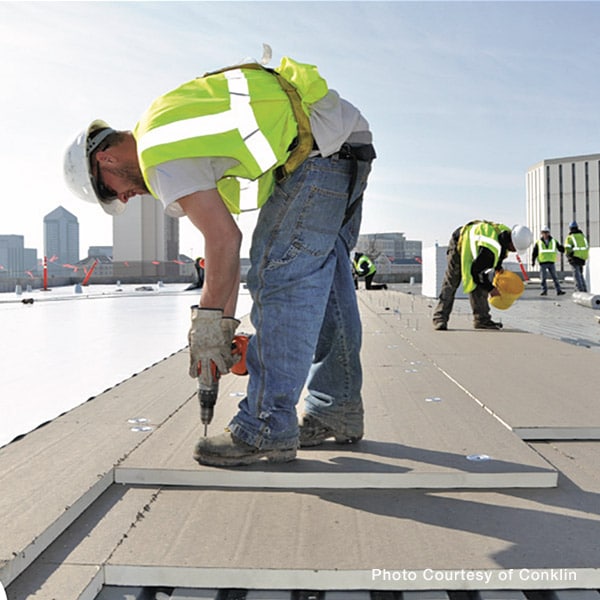
Thermoplastic polyolefin is a single-ply membrane, almost always white, with heat-welded seams. It is currently the most widely installed commercial roofing system in the United States.
The white surface reflects solar energy rather than absorbing it, which lowers cooling load on large flat roofs. The heat-welded seams are strong when properly done, and that is also the catch: TPO roofs generally fail at the seams, and weld quality depends on the installer.
TPO is a strong candidate for coating once weathered. Learn more about TPO roofing.
EPDM Roofing
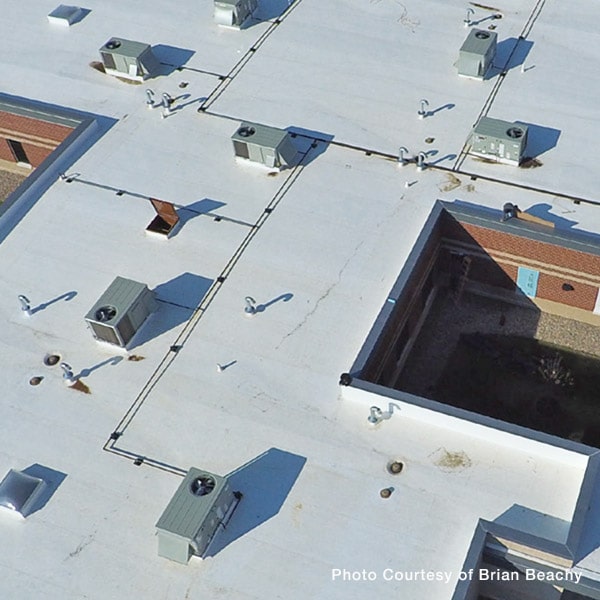
Ethylene propylene diene monomer is a synthetic rubber membrane, usually black, and one of the longest established commercial roofing systems. It has decades of field history behind it, which is why it remains common on flat roofs across Pennsylvania.
EPDM handles cold and thermal movement well, which suits a climate that swings across freezing repeatedly through winter. Seams are adhered rather than welded, so they need checking, and the black surface absorbs heat rather than reflecting it, which works against you in summer.
A reflective coating addresses the heat absorption without replacing the membrane. Learn more about EPDM roofing.
PVC Roofing
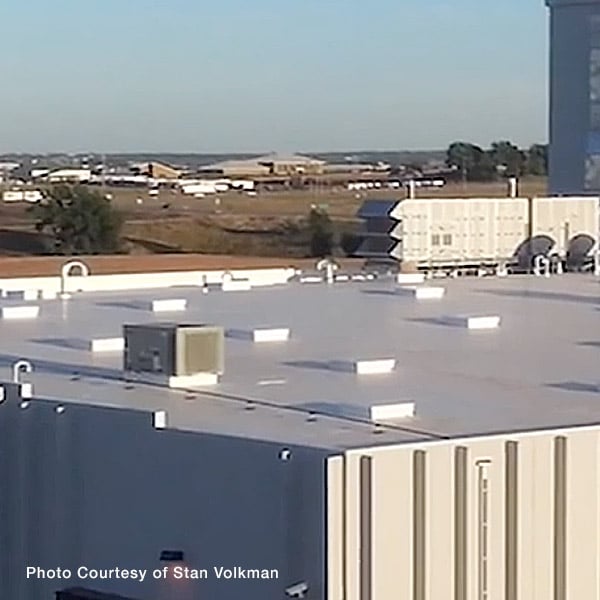
Polyvinyl chloride is the third single-ply membrane, and the one chosen when the roof has to cope with something the others cannot. PVC resists grease, oils and chemical exhaust, which makes it the default for restaurants, food processing and manufacturing plants where rooftop vents discharge onto the surface.
Like TPO it is heat-welded and reflective. It costs more per square foot than TPO or EPDM, so it is generally specified where its chemical resistance is actually needed rather than as a general purpose membrane.
PVC is one of the substrates a restoration coating can be applied over. Learn more about membrane roof repair.

Modified Bitumen Roofing
Modified bitumen is asphalt reinforced with polymer, supplied in rolls and applied in layers. Think of it as the modern descendant of built-up roofing, with the same asphalt basis but far quicker to install.
It suits smaller flat roofs and re-cover projects, and it holds up to foot traffic better than a thin single-ply membrane. The trade-off is the shortest service life of the systems on this page, and dark surfaces that absorb heat unless finished with a reflective cap or coating.
Seams and end laps are the usual failure points, and both respond well to a restoration coating.
Built-Up Roofing (BUR)
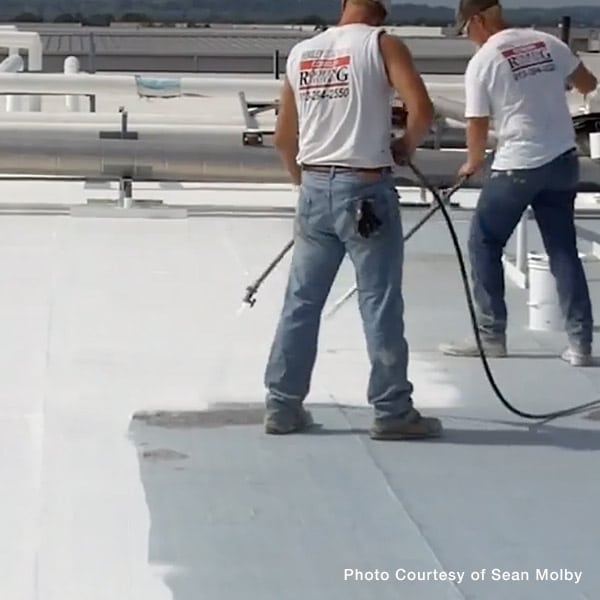
Built-up roofing is the traditional tar and gravel system: alternating layers of bitumen and reinforcing fabric, topped with gravel or a mineral surface. It has been used on commercial buildings for well over a century.
Its strength is durability underfoot. Multiple layers mean there is no single membrane to puncture, which suits roofs carrying equipment and regular service traffic. Its weaknesses are weight, slow installation, and the fact that a gravel surface makes leaks genuinely hard to trace.
Coating a BUR roof removes the tracing problem by sealing the surface as one piece. Learn more about built-up roof restoration.
Metal Roofing
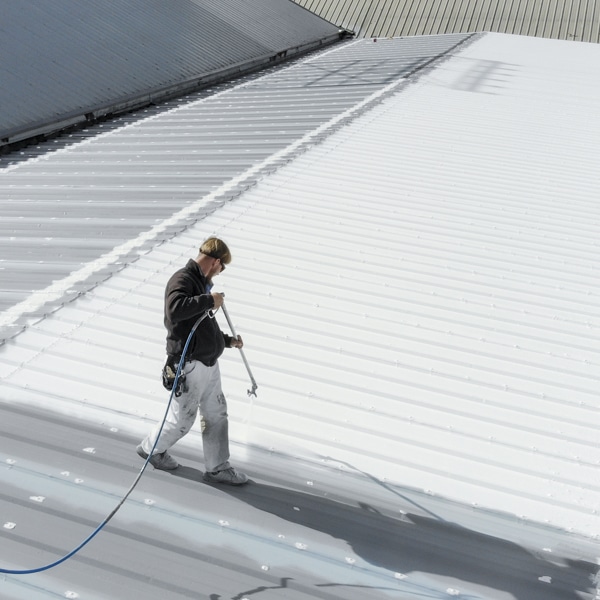
Metal is the outlier on this page, because it is the one system here that is usually sloped rather than flat. It is standard on agricultural buildings, workshops, warehouses and industrial facilities across rural Pennsylvania, and it has the longest service life of any system listed.
The important thing to understand about metal is how it fails. The panels themselves rarely wear out. What fails is the fasteners, whose rubber washers harden and shrink over years of heat and cold, and the seams and flashing details. A metal roof that is leaking in several places is usually not a worn-out roof, it is a roof with worn-out fasteners.
That distinction matters, because it means a leaking metal roof is very often restorable. Learn more about metal roof coatings.
Spray Polyurethane Foam (SPF) Roofing
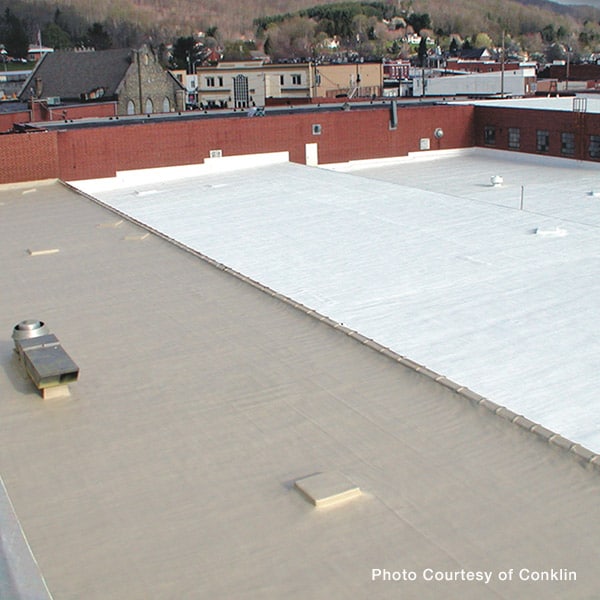
SPF is sprayed on as a liquid, expands into a rigid foam and is then protected with a coating. Because it is applied rather than laid, it forms a seamless surface that follows whatever shape the roof already is.
That makes it useful on roofs with awkward penetrations and irregular geometry, and it adds insulation at the same time, which none of the membranes do. It can also be sprayed to build slope toward drains on a roof that ponds.
The limitations are practical: application depends on dry, mild conditions, and the protective coating has to be renewed periodically. Learn more about SPF roofing.
Which Commercial Roofing System Is Best for Your Building?
There is no single best commercial roofing system. The right one is decided by the building, not by the material. Four questions settle most of it.
Does the roof drain properly?
If water sits on the roof after rain, that narrows the field before anything else is considered. Ponding is hard on every system, and it rules out some coatings entirely. Fixing drainage, or specifying for it, comes before choosing a membrane.
What comes out of the rooftop vents?
Grease, oils and chemical exhaust degrade TPO and EPDM. If the building is a restaurant, a food plant or a manufacturing facility venting onto the roof, PVC is usually the answer.
How much traffic does the roof take?
Roofs with HVAC plant and regular service visits need a surface that tolerates being walked on. Built-up roofing and modified bitumen handle it better than a thin single-ply membrane.
Is the roof flat or sloped?
Sloped roofs on agricultural, industrial and workshop buildings are metal territory. Flat and low-slope roofs are membrane territory. Very little crosses over.
One more consideration that gets missed: if the building already has a roof in sound structural condition, the real choice may not be between roofing systems at all. It may be between replacing and restoring.
Which Commercial Roof Types Are Most Energy Efficient?
Reflectivity is what drives cooling cost on a large commercial roof, and colour does most of the work.
White membranes reflect solar energy rather than absorbing it. TPO and PVC are white as standard. EPDM is black as standard, and modified bitumen and built-up roofs are dark unless finished with a reflective surface. Metal varies with its finish.
A roof that is dark today does not have to stay that way. A white reflective coating over an existing membrane or metal roof changes its thermal behaviour without replacing it, which is usually the cheapest route to a cool roof on an existing building. Conklin coatings carry EnergyStar and Cool Roof Rating Council ratings, and can lower cooling costs by up to 30%.
Can an Existing Commercial Roof Be Restored Instead of Replaced?
Often, yes. Where the deck and structure are sound and the insulation is dry, a restoration coating can be applied over the existing roof rather than tearing it off.
The Conklin system we install is compatible with metal, TPO, EPDM, PVC, modified bitumen, built-up and SPF roofs, which covers every system on this page. Problem areas are repaired first, then the coating is applied to form a seamless, reflective, waterproof surface over the whole roof.
Where the system is suitable, it carries a 20-year non-prorated manufacturer warranty, with the option to renew for a further 20 years, subject to the system installed and its renewal requirements. Lester’s Roofing & Carpentry also provides its own 3-year contractor workmanship warranty.
Restoration is not right for every roof. A roof with saturated insulation, a failed deck or widespread structural deterioration needs replacing, and an inspection is what separates the two cases. Learn more about commercial roof restoration.
Commercial Roofing Contractor in Pennsylvania
Lester’s Roofing & Carpentry is a certified Conklin Roofing Systems contractor based in Rossiter, Indiana County, with over 16 years of experience on commercial, industrial and agricultural buildings. We work throughout Indiana, Cambria, Clearfield and Jefferson Counties and surrounding areas.
Free Commercial Roof Inspections in Pennsylvania
Not sure which system is on your building, or whether it can be restored? Lester’s Roofing & Carpentry provides FREE roof inspections for commercial, industrial and agricultural facilities across Pennsylvania. We will identify the roofing system, assess its condition, and tell you plainly whether restoration is an option.
Call Lester’s Roofing & Carpentry at 814-952-2469 to arrange a free commercial roof inspection.