
Central City Roofing
Lester’s Roofing & Carpentry works on roofs in Central City and across the high ground of northern Somerset County. We handle commercial, industrial, agricultural and residential roofing: leak repairs, metal roof work, restoration coatings and replacements.
We are based in Rossiter, Indiana County, and we have been roofing in this part of Pennsylvania for over 16 years. We are a certified Conklin Roofing Systems contractor and a registered Pennsylvania Home Improvement Contractor, HIC #PA042939.
Call 814-952-2469 for a free roof inspection in Central City.
Roofing Services in Central City
- Roof leak repair. Finding where water is actually entering the building, which is rarely directly above where it appears inside.
- Metal roof repair and coating. Ridge caps, edge trim, fasteners and seams, which is where exposed metal roofs come apart first.
- Roof restoration. Coating a sound roof rather than tearing it off, where the deck and insulation allow it.
- Roof maintenance. Scheduled inspections, drainage clearing and small repairs, with the written records a warranty needs.
- Residential roofing. Repairs, shingle work and metal roof installation on homes.
- Free roof inspections. On any building type.
Wind Is the Defining Problem Up Here
Look at the ridgelines around Central City and you will see wind turbines. They are there for a reason. Somerset County has some of the most consistent wind in Pennsylvania, which is why the commercial wind farms were built here and not somewhere else in the state.
That is good news for power generation and bad news for roofs, because sustained wind is harder on a roof than the occasional storm gust that most roofing is specified for.
The important thing to understand is that wind does not lift a roof from the middle. It gets under an edge. Air flowing over a building accelerates at the corners, the eaves, the rake and the ridge, and the pressure difference it creates there is several times what it is out in the field of the roof. Everything else follows from that.
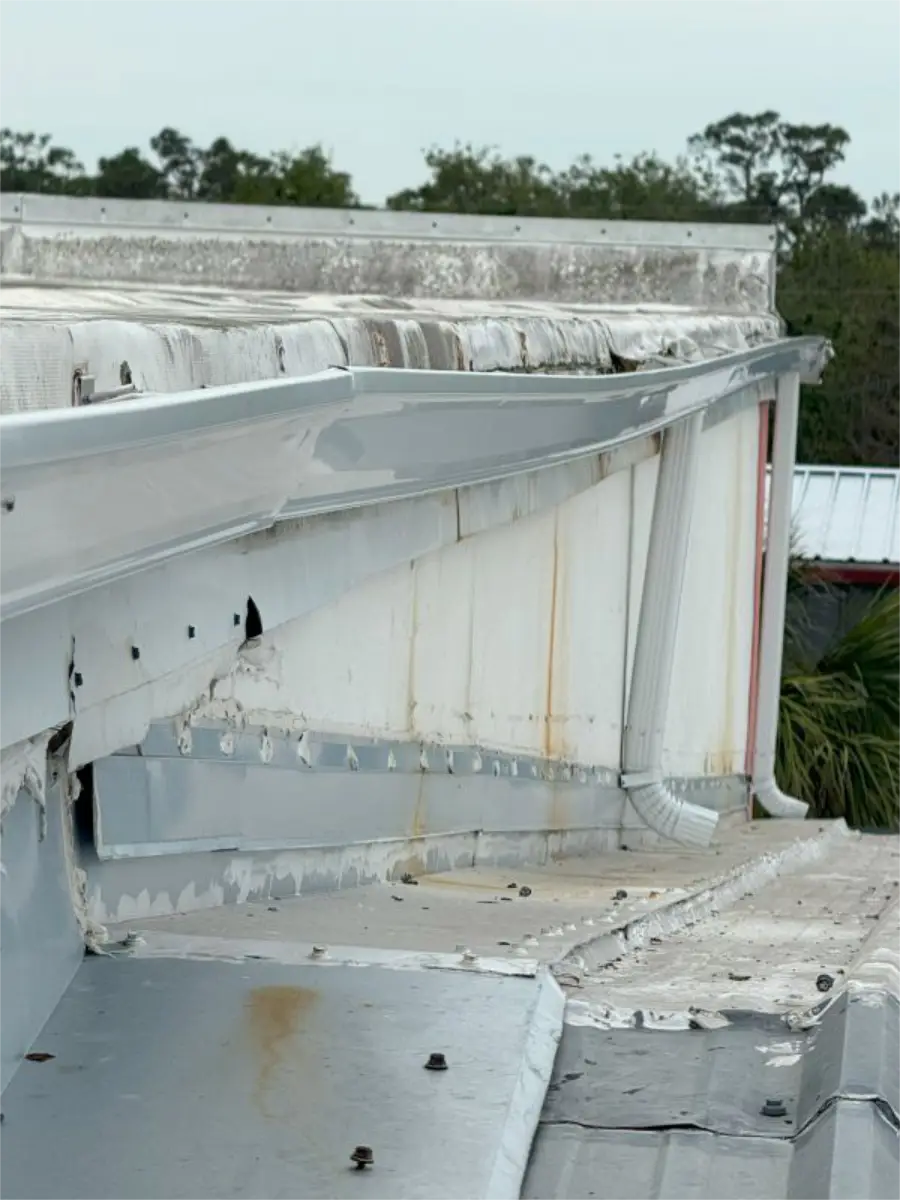
What Wind Damage Actually Looks Like
People expect wind damage to look dramatic. Most of the time it does not, which is why it goes unnoticed for years.
On a shingle roof: tabs along the rake and the first few courses above the eave lose their seal. They lie flat again when the wind drops, so from the ground the roof looks fine. Underneath, each one is now a flap that lets driven rain in and that will eventually tear. If you have found shingle granules in the gutters or a tab in the yard, the roof is already past this stage.
On an exposed metal roof: the ridge cap and the edge trim work loose first. Screws there take the most load and are usually the ones that back out or elongate their holes. A ridge cap that has lifted even slightly turns the whole ridge line into an opening that drives snow straight into the building.
On a low-slope membrane: the perimeter is what matters. If the edge metal or the termination bar has loosened, wind gets under the membrane and starts to peel it. A membrane billowing in wind is the warning sign, and it comes before the failure, not with it.
The practical version of all this: when we inspect a roof in Central City, we spend most of our time at the edges and the ridge. That is where the answer usually is.
Snow, and Why Somerset County Gets More of It
Central City sits high, at roughly 1,900 feet, on ground that catches weather coming across from the west before it reaches the lowlands. Somerset County regularly records the heaviest snowfall totals in Pennsylvania.
Two consequences for a roof. Accumulated load is real here, especially on low-slope commercial and agricultural buildings where snow does not slide off. And wind-driven snow finds openings that rain never would, because it gets blown horizontally and upward into laps, ridge details and vents that are perfectly watertight against falling rain.
That combination, wind plus heavy snow, is why roofs at this elevation need the ridge and the edges checked before winter rather than after it.
Commercial and Agricultural Roofing Near Central City
Outside the borough the building stock is farms, barns, workshops, equipment sheds and light industrial units, and most of those roofs are exposed-fastener metal.
Those roofs rarely fail in the panels. They fail at the fasteners, where rubber washers harden and shrink through years of heat and cold until they stop sealing, and at the seams and flashings. On an exposed site the wind accelerates that, because every screw is being worked back and forth rather than sitting still. A building leaking in several places at once is usually telling you the fasteners have reached the end of their life, not the roof, and that is a repair and coating job rather than a replacement.
More detail is on our metal roof repair and metal roof coatings pages.
Areas We Serve Around Central City
We cover Central City, Shade Township and the surrounding communities, including Hooversville, Stoystown, Kantner, Shanksville, Buckstown, Reels Corner, Jenner Crossroads and Boswell. Central City is a few minutes from Windber, and we work north from here into Johnstown and Cambria County.
Free Roof Inspections in Central City
We provide free roof inspections on homes, commercial buildings, farm buildings and industrial units throughout Central City and northern Somerset County.
An inspection tells you what condition the roof is genuinely in, where water is getting in if it is leaking, and whether the roof can be repaired or coated rather than replaced. On an exposed site we pay particular attention to the ridge, the edges and the fastener line. You get a written report with photographs and a price based on what we found.
If there has been a windstorm since anyone last looked at your roof, that is the point to book one.
Call 814-952-2469 or get in touch.
Your Local Central City Roofing Company
Call us for an obligation free quote
5 Star Google Reviews





Central City Roofing FAQs
How can I tell if wind has damaged my roof without getting on it?
Look at the gutters and the ground first. Shingle granules washing out of a downspout, a tab or two in the yard, or a strip of edge trim that is no longer sitting flat are all signs. On a metal roof, stand back and sight along the ridge line: a cap that has lifted at one end is visible from the ground once you know to look. What you cannot see from the ground is a shingle that has lost its seal but is still lying flat, which is the most common form of wind damage and the reason an inspection is worth having after a bad storm.
Does heavy snow mean I should worry about the roof collapsing?
On a sound, properly framed roof, almost never. The realistic risk on a low-slope commercial or agricultural building is drifting, where wind piles snow deep against a parapet, a wall or a change in roof height, so one area carries far more load than the rest. If you have a building where snow always drifts in the same place, that is the spot to have looked at.
Can a roof at this elevation be coated instead of replaced?
Often, provided the deck and structure are sound and the insulation is dry. On an exposed site the perimeter and the fastener line have to be properly repaired and detailed before anything is coated, because a coating will not hold down something the wind has already loosened. Where a Conklin restoration system is suitable, it carries a 20-year non-prorated manufacturer warranty, with the option to renew for a further 20 years, subject to the system installed and its renewal requirements. Lester’s Roofing & Carpentry also provides its own 3-year contractor workmanship warranty.
When is the best time to have a roof checked in Central City?
Fall, before the weather turns. Winter at this elevation is long, and it is much harder to do a proper repair in it. Snow and ice expose weak seams, flashing and drainage, and those problems usually show up as leaks during a thaw rather than during the snowfall itself, by which point the damage inside has already been done.